
Happy Hanukkah!
So I recently watched several French films and, purely by accident and not design, there was a common denominator among them -- the actress Ludivine Sagnier. Sagnier started as a child actress and has gone on to amass a very respectable resume, perhaps most notably Swimming Pool with Charlotte Rampling. The films I watched were Moliere; Les chansons d'amour (Love Songs); La fille coupee en deux (A Girl Cut in Half); and Un secret (A Secret). Whether playing a leading role or a supporting one, Sagnier proved to be a luminous and arresting screen presence. She's fast becoming one of my favorite actresses and I'm awaiting the release of the acclaimed dyptich Mesrine which has been scheduled for sometime in 2010, not only because she's in it, but because it stars one of my favorite actors Vincent Cassel.
Moliere shares some of the same DNA as the film Becoming Jane. Both are speculations on the lives of a famous writer about whom there is incomplete information, both are period pieces, and both draw parallels between the author's life and his/her work. Jean-Baptiste Poquelin a.k.s Moliere (Roman Duris) is a playwright and actor who has been constantly touring the French countryside with a troupe of actors. He wants to settle down and craft more "serious" work than the crowd-pleasing comedies that have become the company's stock in trade. When the film opens, he has returned to Paris and is summoned to the deathbed of a mysterious individual.
The movie then flashes back more than a decade when Moliere was about to be imprisoned for racking up a large debt. He is "saved" by a wealthy merchant (Fabrice Luchini) who agrees to pay the debt if Moliere will assist him with a play he has written that he hopes will impress a local widow (Sagnier). Moliere poses as a tutor hired to instruct the rich man's daughters and also catches the attention of the lady of the house (Laura Morante). Borrowing from Tartuffe, The Imaginary Invalid and The Misanthrope, among others, the film weaves an intermittently entertaining tale. What elevates Moliere are the strong performances. Duris is usually cast as dour sorts so it's nice to see him get to cut loose and display his comedic side. He deftly handles the role and strikes sparks with Laura Morante as the neglected homemaker. Luchini captures the follies of a man led not by his heart but by another organ. Sagnier is note perfect as the frivolous widow who is more than aware of her charms. While there is a schematic feel to the film, Moliere is an enjoyable way to pass a few hours, particularly if you like theater, especially farce.
Rating: C+
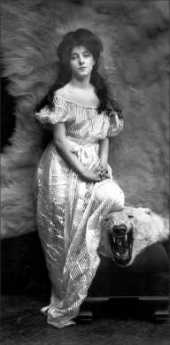
A Girl Cut in Half is Claude Chabrol's modern-day version of the Evelyn Nesbit story. Evelyn who? Her story has been told on screen in The Girl in the Red Velvet Swing (with Joan Collins) and Ragtime (with Elizabeth McGovern earning an Oscar nomination). In a nutshell, in 1906, Nesbit was a model who became something of a celebrity because of her affair with architect Stanford White who was shot to death by Nesbit's unstable husband Harry K. Thaw. When Thaw's case hit the courts it was dubbed "the murder of the century" -- this was eighty-something years before O.J. Simpson.
Chabrol and his co-scenarist Cecile Mastre utilized the outlines of the case to craft their plot. Gabrielle (Sagnier) is a local TV weathergirl on the rise. She soon catches the romantic attentions of two gents, Paul (Benoit Magimel), the wealthy scion of a family who owns a pharmaceutical firm, and the older successful novelist Charles (Francois Berleand).
Chabrol has often been compared with Hitchcock and Sagnier's character is a relative of the many cool, icy blondes that populated Hitchcock films. The audience isn't clued into the reasons why she dallies with these distinctive men, although there are hints that she may be seeking a father figure in the older writer, and, of course, there's the cliche that every woman is attracted to the "bad boy". In any case, this is a love triangle that will end in tragedy; getting there is the thrust of the film and it's a bumpy but satisfying ride.
Sagnier does what she can with a slightly underwritten role. Berleand is forceful and charming, while Magimel walks off with movie. There's fine support from Caroline Silhol as Paul's snobbish mother and Matilda May as Charles' publisher. It's all very Chabrolian, and if you are a fan of the director's work (as I am), then you'll like this movie, even if it is not top shelf.
Rating: B
In Un secret (A Secret), Sagnier has a pivotal supporting role. This is a film that is difficult to write about because one doesn't want to give away too much of the plot. It is based on an autobiographical novel by Philip Grimbert and centers on Francois, a character the audience meets at various stages in his life. He is seen as a child, a teenager and an adult, all played by different actors, and the plot revolves around his uncovering a long-buried family secret that is partly based on religion and partly on a more taboo issue. Sagnier is terrific in her role but the movie really centers on Francois' parents (Patrick Bruel and Cecile De France), although Julie Depardieu as a family friend (and keeper of the secret) delivers the best performance. Directed by Claude Miller.
Rating: B-
And in what is my favorite of this quartet, Les chansons d'amour (Love Songs), Sagnier again plays a pivotal role.
First off, this is not a remake of the 1986 Catherine Deneuve film that bore the same title in English -- although it does feature Deneuve's daughter Chiara Mastroianni.
This is a musical, directed by Christopher Honore, and set in contemporary Paris. As the film opens, Julie (Sagnier) and her lover Ismael (Louis Garrel) are experiencing troubles in their relationship. To spice things up, they enjoy the occasional threesome with Alice (Clotilde Hesme), Ismael's co-worker. Julie's family has embraced the young man, but her mother (Brigitte Rouan) is shocked when she learns of the arrangement. While Julie claims that she agreed to the arrangement to hold on to Ismael, she also confesses that there are aspects which she enjoys.
An unexpected tragedy occurs which forces the various lovers apart and into new arrangements. Ismael deals with conflicting emotions and eventually makes a suprising choice. Since the film is called "Love Songs" -- one can gather that it focuses on the healing powers of that emotion.
Did I mention that this is a musical? In fact, one of the better musicals I've seen in years. Yes, the actors aren't trained singers, but that's part of the film's charm. The fourteen songs in the movie, all written by Alex Beaupain, aren't all that memorable -- you don't hum them afterwards -- but in the context of the plot, they work quite well. The best number is a mournful lament delivered by Chiara Mastroianni.
Sagnier is terrific as the conflicted Julie. Hesme is fine as the pragmatic Alice. Gregoire Leprince-Ringuet offers fine support as a puppyish suitor and Alice Butaud as Julie's other sister also registers, as do Brigitte Rouan and Jean-Marie Winling as Julie's parents. Garrel anchors the film, deftly taking a somewhat selfish lout on a journey in which he opens up his heart.
I have seen Love Songs several times now and with each viewing I discover more to it, like re-reading a good novel. This is easily one of my favorite films of the last decade and ranks along with Once as a wonderful musical and a bittersweet romance.
Rating: A-


Subscribe to:
Post Comments (Atom)
No comments:
Post a Comment